
Since 2012, the Penn Program on Regulation has organized an annual Distinguished Lecture on Regulation, bringing to campus prominent government officials, legal scholars, regulatory practitioners, and business leaders, all with deep experience in regulatory law and policy, who share their insights with students, faculty, and others within the Penn Law community.
The 2025 Distinguished Lecture on Regulation was delivered by Gary Gensler, Chair of the U.S. Securities and Exchange Commission from 2021-2025. Coverage of Gensler’s remarks will be published in The Regulatory Review later in 2025.
Administrator, U.S. Office of Information and Regulatory Affairs
AnBryce Professor of Law, New York University School of Law

As Administrator of the White House Office of Information and Regulatory Affairs (OIRA) during the Biden Administration, Richard L. Revesz has led the component of the Executive Office of the President of the United States charged with coordinating the review and analysis of significant federal regulations. In this lecture, Revesz examines the history of centralized review of agency actions in the U.S., describes current challenges to centralized review that OIRA has had to confront, and highlights ways in which the Biden Administration has sought to implement important reforms to the regulatory process.
Board Member, Public Company Accounting Oversight Board
Former Commissioner, U.S. Securities and Exchange Commission

In this lecture, Public Company Accounting Oversight Board Member Kara M. Stein considers the regulatory implications of the rapid technological changes that are rippling through today’s economy, especially with the introduction of new forms of artificial intelligence. She argues that in an increasingly digital world, the U.S. “regulatory paradigm” must shift from “Regulation 1.0,” in which regulatory agencies primarily have required and processed paperwork and targeted people, to “Regulation 2.0,” in which regulators themselves not only make use of AI technologies to enhance their work, but also participate in determining how government can best oversee the dramatic technological advances that are disrupting the economy.
Director, Consumer Financial Protection Bureau
Former Commissioner, Federal Trade Commission
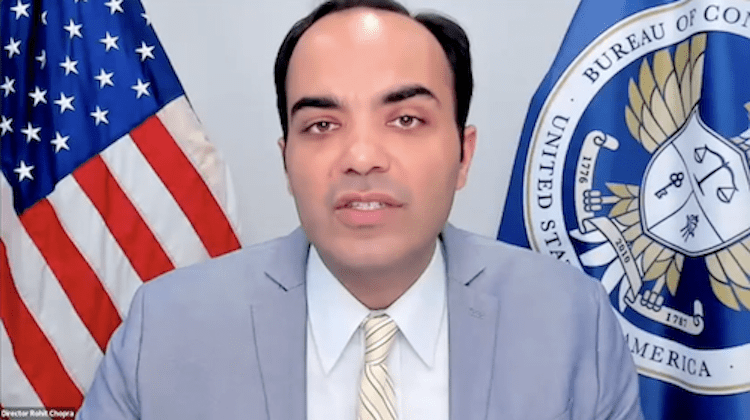
Large institutions, financial or otherwise, have been shown to repeatedly violate the law and past orders. These entities face a low probability of detection of violations and consumer abuses, and even when violations and abuses are detected, ensuing government orders rarely deter future misconduct. Instead, according to CFPB Director Rohit Chopra, big corporations view such orders as a “cost of doing business”—and American consumers are not only harmed, they also are left to subsidize corporate malfeasance. In this lecture, Director Chopra shares how the CFPB will sharpen its focus on repeat offenders in an effort to deter such behavior.
Charles Ogletree, Jr. Professor of Law, Harvard Law School

In this lecture, Professor Guy-Uriel Charles explains how recent U.S. Supreme Court decisions have weakened the Voting Rights Act and undermined its race-based model for protecting voting rights, exploring what the implications are for the future of voting rights in today’s politically polarized and racially stratified society, where many states are considering changes to voting rules. Professor Charles’s lecture also was part of the 2021-2022 Lecture Series on Race and Regulation.
Professor of Practice and Distinguished Scholar in Residence, New York University School of Law; Former Administrator, U.S. Office of Information and Regulatory Affairs

Every day, regulations affect our lives—helping to keep roads safe, water clean, electricity running, and so much more. In this lecture, Sally Katzen reflects on how these regulatory benefits are too often “hidden in plain sight.” Many people not only fail to recognize these benefits, but they disparage the very idea of regulation as costly, bothersome, and damaging to their economic interests. Professor Katzen, who served in the Clinton Administration as administrator of the Office of Information and Regulatory Affairs, and then as deputy assistant to the president for economic policy and deputy director of the National Economic Council, suggests why this neglect occurs, discusses its consequences, and explains what all of us can do to make regulation and regulatory benefits less hidden.
Paulette Goddard Professor of Public Service, New York University

Between December 22, 2018 and January 25, 2019, the U.S. experienced the longest government shutdown in the nation’s history. For those 35 days, operations across nine executive departments were severely curtailed or ground to a halt entirely, disrupting critical federal services and diminishing public trust in government. In this lecture, Professor Paul C. Light sees a possible silver lining in that ordeal, and offers a vision for how it could inspire long-overdue reforms of the federal civil service system.
Former Administrator, U.S. Environmental Protection Agency

Gina McCarthy, who headed the U.S. Environmental Protection Agency during the second term of the Obama Administration, reflects on efforts of the Trump Administration to roll back environmental rules and commitments such as the Clean Water Rule, the Clean Power Plan, and the Paris Agreement. Former Administrator McCarthy also discusses the important role that states, cities, businesses, and citizens can play in sustaining progress on environmental protection.
Partner, Gibson, Dunn & Crutcher

Associate Justice, California Supreme Court
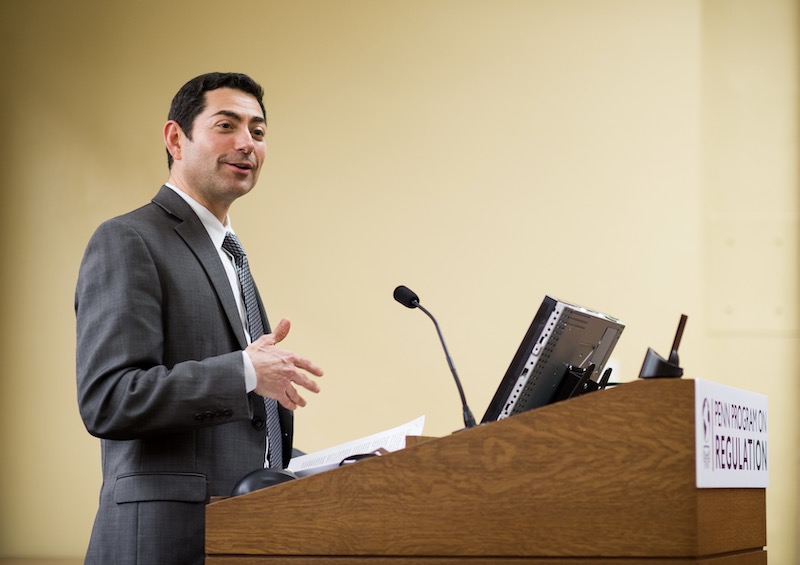
Chairman, Administrative Conference of the United States
Vice President, Environment, Health & Safety, General Electric

Robert Walmsley University Professor, Harvard Law School

Partner, Venable LLP
Penn Program on Regulation
University of Pennsylvania Carey Law School
3501 Sansom Street
Philadelphia, Pennsylvania 19104
regulation@law.upenn.edu
Program Director
Cary Coglianese
+1 215.898.6867
carycoglianese.net